Narrative Events of Queerness. Ethnographic Portraits from the Field
https://orcid.org/0000-0002-0070-5970
This article focuses on the description of an ongoing ethnographic process. It explores the researcher’s first encounter with a new environment and the initial reflections that emerge from a queer and decolonial perspective. Two portraits, of a trans woman and of a group of chola women ascending the summit of Huayna Potosí, are encountered within the central square of Santa Cruz de la Sierra. These images, situated in a space historically shaped by colonial and patriarchal power, become narrative events that evoke questions about visibility, resistance, and the occupation of public space by marginalized bodies.
After a long time, my dear friend Sandro, I still remember our days in that Catholic school and how our lives were shaped by the beliefs and morals imposed there. Today, I want to share with you my first impressions of Bolivia and queerness through two portraits of non-heterosexual people.
Before I go further, I should situate myself. My own non-heterosexual identity, my childhood in Nicaragua, and my years living in Switzerland shape the way I see, interpret, and connect with the people and images I encounter. This positionality is not a fixed standpoint but a shifting lens, one that is reframed by every step I take in the field, compelling me to question my prior understandings of queerness, indigeneity, decoloniality, and my own sexual identity.
Entering a new space means being open to unlearning, to being unsettled, and to recognizing how my own gaze intersects with the lives and struggles I seek to understand, a process of being reborn.
Sandro, ethnographic research is inherently tied to the act of arriving at a new place, community, or perspective, and it requires an openness to learn through living and observing within this unfamiliar context. My case, centered on queer Indigenous young people, demands that I pay attention to how terms, realities, and experiences such as desire and sex-affective relationships function within an ethnicized context. This requires localizing and redefining many of the western terms and queer perspectives I have learned, we have learned. My next approach may appear somehow inflexible, but I believe that ethnographic work as a part of academic process can only be decentralized and decolonial when we immerse our methods, terminologies, and analyses in the lived realities of those we study. In this text, I share a reflection on my first experience in Bolivia, viewing it as a key part of my ongoing learning journey.
To achieve this, it is necessary to situate my knowledge production within a larger framework of decolonial approaches, which requires dismantling and reconfiguring concepts, terms, and their definitions. In this ongoing work, I attempt to reconstruct these elements based on the everyday experiences of non-heterosexual Indigenous individuals from the Bolivian highland cities of La Paz and El Alto, with their own mobilizations, challenges, and forms of resistance.
Why use a decolonial and queer perspective in my analysis? While this might seem complex, I believe it is essential to write and read from non-Western viewpoints to create a more nuanced and richer understanding within gender and anthropology studies. In A Critique of Postcolonial Reason, Gayatri Spivak addresses how subaltern and marginalized subjects, marginalized by both colonialism and the evolution towards hegemonic systems, are often represented in distorted ways to benefit the Western subject and commonly misunderstood within academic epistemologies (Spivak 1999). Similarly, Marisol de la Cadena in “¿son los mestizos híbridos?,” examines the representation of the “Indian,” which is frequently reduced to clichés that erase the diversity and complexity of Andean identities within a racist discourse (de la Cadena 2006).
These concerns resonate with critiques of how the colonial influence and Western gender and sexuality frameworks travel and interact with local epistemologies (Moussawi 2015; Massad 2002). Such frameworks transform the ways in which identities are negotiated, read, and represented, often involving ongoing contestations over meaning. As Kreil, Sorbera, and Tolino remind us, the translation of terms like “queer” or “LGBT” is never neutral; it entails negotiations, resistances, and re-significations that shape their local meanings and political uses (Kreil, Sorbera, and Tolino 2020).
I also engage here with Peter Wade’s framing of Indigenous people, as outlined in “Repensando el mestizaje” (Wade 2003), where he emphasizes an image of the mestizo as a category shaped by racism and power dynamics. His analysis of mestizaje in Latin America has frequently been seen as linking a process of national homogenization idea, while hiding a reality of racist exclusion behind a mask of inclusiveness. While exclusion is an undeniable reality, this perspective urges us to rethink how we write about and conceptualize the “other,” and how we can challenge narratives that perpetuate hegemonic perspectives.
Transitioning from theory to practice, I realized that the ethnographic process itself requires a form of rebirth—a willingness to begin anew, to immerse oneself fully, and to reconfigure our analytical frameworks in light of the lived realities encountered in the field.
After over three years spent formulating the proposal for this project, I am finally able to be in the field in Bolivia. Walking through the streets of Santa Cruz seems incredible as each detail offers a glimpse into an entirely new perspective. I find myself living in a new place with a different viewpoint, a series of elements that signify new experiences for me.
What surprises me most is the excitement of finally being able to carry out the ethnographic part of my work, which I started to develop virtually through audiovisual media and social networks due to the COVID-19 pandemic and travel restrictions. It’s worth mentioning how complex it was for a country like Bolivia to resume its “normality” after the health crisis.
The idea of “becoming newborn to situate ourselves,” of viewing the ethnographic process as a kind of rebirth, feels particularly meaningful for me. Like a newborn is compelled to activate a heightened perceptual system to observe, listen, learn and to reflect, Cuestas and colleagues view ethnographic work in a new environment as a process of stepping beyond the familiarity of our usual surroundings (Cuestas et al. 2018). While this comparison may be somehow unconventional, it resonates with my personal experience of being “born in the field,” experiencing a deeper situational awareness and clarity of purpose in the research. Upon arrival, one undergoes a kind of personal reconstruction, an immersion in the local codes of social behavior and interaction, alongside distinctive sensory experiences—the scents, colors, customs, foods, and modes of transportation that comprise daily life.
My earliest memory of Bolivia is tied to the media coverage of Evo Morales’ victory in 2006, which represented a transformative moment in Latin American politics, especially with the election of a leader who identified himself as an Indigenous and became president of the state. At the time, I was 16 years old, and in the midst of navigating my adolescence time, coming to terms with my own identity as a non-heterosexual person. Although I could not yet fully grasp the magnitude of this political event, the reaction of the adults around me made me aware of its significance, as it challenged the racist and classist structures of Latin American societies, where the figure of the “Indian” is still read as ignorant.
Years later, I went to Bolivia to lead this ongoing research on the ethnic identity of Indigenous subjects and their sex-affective expressions of non-heterosexual bodies. These expressions, grounded in their own understandings of their social and ethnic codes, seek to articulate new perspectives that are more precisely attuned to their realities.
My journey to Bolivia , began in Santa Cruz at Viru Viru Airport, the busiest terminal in the country, Sandro. The airport is relatively small compared to the significance of Santa Cruz, the most populated and economically active city of the country. However, the airport’s primary role is to connect Bolivia with neighboring countries such as Brazil, Argentina, and Chile. I was surprised by the scarcity of direct air connections from Europe and North America and the reliance on land travel instead. This undoubtedly reflects the impact of the pandemic when Bolivia closed its airspace early in 2020 and only reopened it in September of the same year, under strict regulations.
My entry into the country was relatively smooth, though the immigration process involved questions about my intended length of stay. When explaining to the immigration officer that I was a researcher requiring a permit for a stay beyond 90 days, I intentionally avoided using terms like “homosexuality,” “queer,” “Indigenous,” “feminism,” or “decoloniality,” due to the politically charged climate at the time, particularly the “Con mis hijos no te metas” (“Don’t mess with my children”) campaign, which strongly opposed educational reforms promoting sexual education in schools.
I was walking in Santa Cruz with a head full of thoughts, expectations, and apprehensions. Fieldwork is always unpredictable; we never know quite how the terrain or social interactions will unfold. Although I have prior experience in ethnographic research and in working in other Andean countries and with leaders in Indigenous organizations, I find myself both nervous and excited for what lies ahead.
My first walk in Santa Cruz, Bolivia, takes place in the central square, Plaza 24 de Septiembre, named in commemoration of the city’s independence movements. Here, a small photography exhibition caught my eye. Adjacent to the plaza stands the Cathedral of San Francisco, a symbol of the Catholic heritage and contemporary faith that define this Bolivian city. Plaza 24 de Septiembre is an emblematic, open public space, bordered by well maintained trees and gardens that provides a central meeting point for people of all ages.
The surrounding colonial style buildings, rich in architectural heritage, underscore the plaza’s historical significance and lend the city an air of aristocratic refinement, reflecting its unmistakable legacy of a colonial past in which religion, politics, and societal power held prominent roles. At the same time, these elements seem to influence the way cruceños, the city’s inhabitants, are represented in the Bolivian imagination, which people from other regions often describe as white, modern, and representative of the “national culture.”
I have always felt a deep admiration for colonial religious buildings, likely shaped by my Catholic upbringing and education in religious institutions, which often leads me to romanticize these historic monuments. Thus, my first impression of the plaza was its vastness, with towering, lush trees typical of a warm, lowland climate. The rich vegetation provided a refreshing breeze to the center of the plaza on the sunny afternoons of the city. The long, intricately crafted benches, made of wood and metal, offer the perfect setting to enjoy the place and admire the beautiful facade of the Cathedral of San Francisco.
It was around 3:30 in the afternoon, and the plaza was beginning to fill with visitors. It is common to find many street vendors offering everything from street food and sweets to colorful handicrafts. I am struck by the art and the interplay of colors in the small curiosities and objects these vendors present as Bolivian art. The plaza, surrounded by colonial-era buildings, seemed to be an ideal space for gatherings, not only for the locals like the cruceños, but also for those like myself, seeking a place to meet the locals.
Among the images in the Plaza, one in particular held my gaze: the photograph depicted part of a trans woman’s body, her breasts semi-exposed, yet her face was not shown. The woman appeared to be dancing to carnival music, wearing an outfit suited for the occasion. I read the picture and the body of this trans woman, through her movement and attire, as displaying a blend of empowerment and self-celebration. She wore long nails, painted in a pink-black hue with gleaming pearls, a pink top that covered her breasts, and a tattoo that stretched from the center of her chest to her navel. The photograph culminated with an image of a short pink skirt, capturing a dance pose. The bright colors of her outfit, combined with the energy of her dancing body, seemed to merge perfectly in a celebration of diversity, honoring both visibility and resistance.
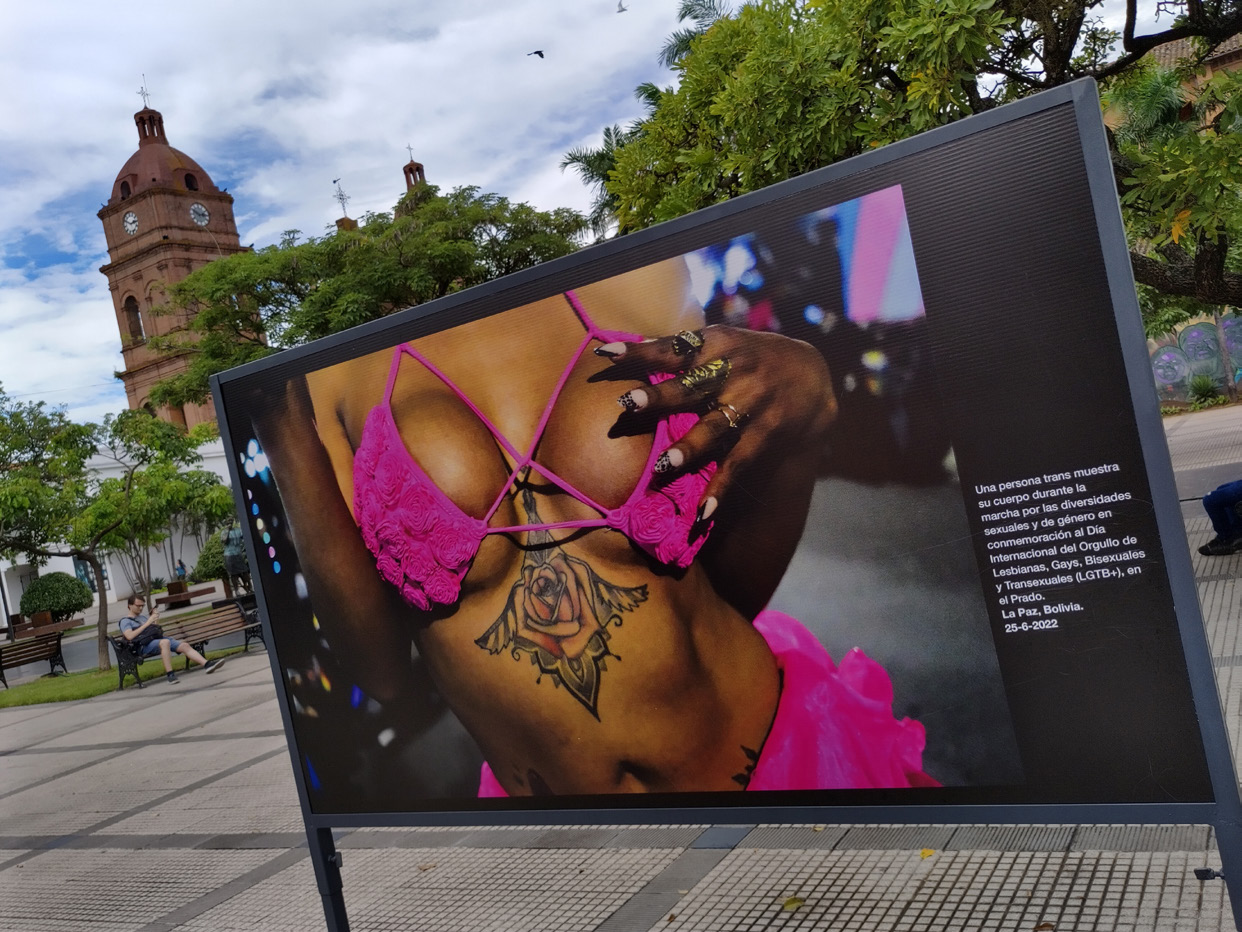
Although the image did not reveal her face, the confident and powerful presence of her body evoked a deeper reflection in me. In my mind, the dancer’s absent face became one of struggle and vulnerability, a face of triumph born from the determination that shaped her into who she is, an identity celebrated for its visibility, its strength, and the empowerment it radiated.
The caption accompanying the photograph reads: “A trans person shows her body during the march for sexual and gender diversity in commemoration of Lesbian, Gay, Bisexual, and Transgender (LGBT+) Pride in El Prado, La Paz, Bolivia.” This caption, along with the image, simultaneously revealed to me the complexities and contradictions that define the experiences of trans people in Bolivia. In a sociopolitical context where dissident, queer, and non-binanry identities still contend with a prevailing religious morality, the trans body like that of the woman in the photograph becomes an act of visibility and resistance. In Bolivia, where the Catholic Church and other Christian faith continue to play a fundamental role in social structures, representations of sexual diversity are often viewed with suspicion or misunderstanding, making the visibility of these bodies a direct challenge to dominant norms and values.
This contrast between the presence of queer bodies and the omnipresence of religious symbols that dominate public space creates a latent tension, a clash of worlds. Rooted in centuries of colonial and patriarchal dominance, religious morality attempts to silence or render invisible those bodies that defy its norms. However, through visible representations like these, dissident bodies find ways to claim space, challenge a system that marginalizes them, and autonomously rewrite their stories.
In this same plaza, I encounter a photographic representation of an other understanding of feminity, Indigenous cholas1, women ascending Huayna Potosí2.
The chola, the Indigenous woman who, regardless of her ethnic origin, chooses to wear traditional attire such as the pollera. With this choice, the chola rejects the categories of “miss” or “madam” to simply be chola. These women have played a crucial role in shaping Bolivian Indigenous identities, donning clothing inherited from colonial times, characterized by long, voluminous, and colorful skirts, a hat, and long hair typically braided into two plaits. They carry within them a culture of vibrant colors and a history of struggle and resistance.
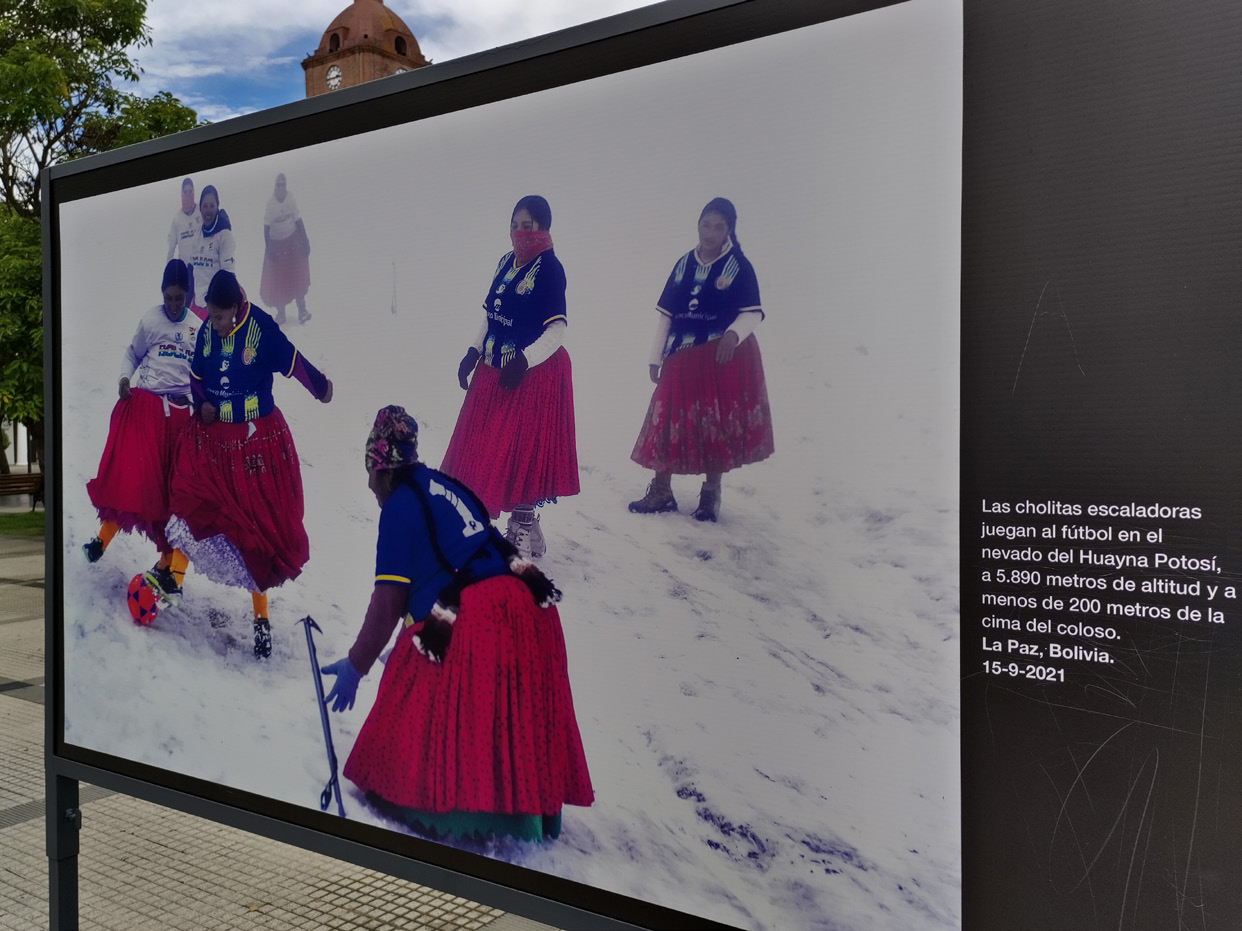
The figure of the chola, as members of the Maricas Bolivia collective explain, has undergone a process of reclamation from the pejorative designation of “a woman, Indian, and ignorant” to becoming a national and international symbol for Bolivian identity.
This image, laden with significance, speaks not only to a physical feat of endurance but also to a symbolic and political resistance against colonial and patriarchal powers that seek to silence Indigenous women. The photograph prompts a deep reflection on how chola women, like trans women, continually negotiate their place and feminity in a society that strives to exclude them from spaces of power, while they, with strength and determination, reclaim these same spaces.
You might be wondering about the purpose of these photographs. Although I wish I had a clear answer, the truth is that I don’t know. This exhibition presented other photographs of emblematic Bolivian moments, yet, as an observer and perhaps due to my own limitations or oversights I don’t recall finding a clear explanation for why these particular portraits occupy public space. Nonetheless, I use the photographs as narrative events (Bal 1997), capable of evoking emotions and meanings within my narrative. They serve as essential elements in constructing a portrait that is as much visual as it is interpretive. What I offer, then, is a perspective and analysis intimately tied to my experience of this moment.
These photographs also serve as a lens through which this work travels and transforms, becoming a concept, a method, or a form of visual literature for each person who encounters it. This process of reconfiguring queer bodies, both in physical and symbolic spaces, embodies the ongoing struggles of resistance that permeate Bolivia. Plaza 24 de Septiembre, due to its location and history, attempts to become an emblematic space of exhibition where diverse identities converge, recognize one another, and fight for their place in society. But what about the other expressions of femininity or non-binary identities?
My arrival in Bolivia and my observations in this plaza allowed me to understand how some dissident and queer bodies, through their visibility in public spaces, challenge the norms imposed by a patriarchal and colonial system. However, there are still other questions without answers. Is it within this encounter between visible and invisible bodies, between religious morality and the struggles for diversity, that the line of conflict marking many of Bolivia’s social tensions is drawn?
Well Sandro, the reflections I have shared with you stem from an ongoing project on queerness and other sexual-affective practices in Bolivia. My own non-heterosexual identity has played a crucial role in understanding the initial elements I have encountered. However, it is important to recognize that this has also encouraged me to question my prior knowledge and my own understanding of queerness.
As a researcher, I would argue that our positionality within the fieldwork environment should be critically examined prior to our departure. This preparatory phase should lead us to an opening process once we arrive in the field, so that we can reconsider and redefine our prior knowledge based on the experience and coexistence in the new environment. As Mieke Bal points out, upon arrival, the traveler (and in this case, the researcher) is already equipped to follow the path, but this time without the concepts of the great or old sages, since the knowledge they reflect belongs to a past that has already faded (Bal 2002). Thus, the task that lies before us is to embark on a process in my case, to imagine it as a newborn in which, with an open disposition, I absorb all that is possible. Only through a process of analysis can we establish epistemologies that are in alignment with the new environment and its reality.
Bal, Mieke. 1997. Narratology: Introduction to the Theory of Narrative. With Internet Archive. Toronto; Buffalo: University of Toronto Press. http://archive.org/details/narratologyintro0000balm_z4m0.
Bal, Mieke. 2002. Travelling Concepts in the Humanities: A Rough Guide. Green College Lectures. University of Toronto Press.
Cadena, Marisol de la. 2006. ‘¿son los mestizos híbridos? las políticas conceptuales de las identidades andinas’. Universitas Humanística 61 (61): 61. https://revistas.javeriana.edu.co/index.php/univhumanistica/ article/view/2075.
Cuestas, Paula, Rodolfo Iuliano, Martín Urtasun, et al. 2018. ‘Nuevas Fuentes de La Imaginación Sociológica: La Operación Reflexiva y La Construcción Del Objeto Etnográfico’. In ¿Condenados a La Reflexividad? Apuntes Para Repensar El Proceso de Investigación Social. CLACSO. https://doi. org/10.2307/ j.ctvn5tzjw.11.
Kreil, Aymon, Lucia Sorbera, and Serena Tolino. 2020. Sex and Desire in Muslim Cultures: Beyond Norms and Transgression from the Abbasids to the Present Day. I. B. Tauris. http://hdl.handle.net/1854/LU-8700046.
Margarucci, Ivanna. 2023. ‘Protagonistas Entre La Visibilidad Local Y Transnacional: Las Cholas Anarquistas De La Paz, Bolivia, 1927–1931’. Historia Social, no. 106: 143–62. https://doi.org/10.70794/ hs.103200.
Massad, Joseph. 2002. ‘Re-Orienting Desire: The Gay International and the Arab World’. Public Culture 14 (2): 361–86. https://doi.org/10.1215/08992363-14-2-361.
Moussawi, Ghassan. 2015. ‘(Un)Critically Queer Organizing: Towards a More Complex Analysis of LGBTQ Organizing in Lebanon’. Sexualities 18 (5–6): 593–617. https://doi.org/10.1177/1363460714550914.
Spivak, Gayatri Chakravorty. 1999. A Critique of Postcolonial Reason: Toward a History of the Vanishing Present. Harvard University Press.
Wade, Peter. 2003. ‘Repensando el mestizaje’. Revista Colombiana de Antropología 39 (January): 273–96. https://doi.org/10.22380/2539472X.1243.
Jos Meléndez Duarte (no pronouns) is a PhD candidate at the Interdisciplinary Center for Gender Studies (IZFG), University of Bern, and a research assistant at the école de Travail Social, HES-SO Geneva. Their current research focuses on queer and cuir epistemologies and decolonial knowledge production emerging from the activism of a new generation of Indigenous people in Bolivia’s urban centres. They explore how these subjects negotiate the politics of desire and their Indigenous and sexual identities within a critical decolonial framework that challenges hegemonic LGBTIQ+ narratives.
jose.melendez@faculty.unibe.ch
Interdisciplinary Center for Gender Studies, University of Bern
Ivanna Margarucci, in her article “Protagonista entre la visibilidad Local y Transnacional: Las Cholas Anarquistas de La Paz, Bolivia 1927–1931,” offers a historical journey through the roles chola have held at various points in Bolivian history, focusing particularly on their participation in anarchist organizations ( Margarucci 2023). Today, Bolivian chola stand as symbols of resilience, bridging Bolivia’s past and present, making them essential for understanding contemporary feminist, Indigenous, and queer movements in B olivia.⬑
Huayna Potosí, one of the most emblematic mountains in the Bolivian Andes, is located near La Paz and is a popular destination for many international climbers. At 6 088 meters above sea level, it is one of the highest peaks in the Andes. Its summit remains snow-covered year-round, and the mountain also hosts glaciers of great importance to Bolivia, which are now at risk due to global warming.
Beyond its allure, Huayna Potosí is essential within the human-nature relationship. For much of the Indigenous population, the mountain is part of Pachamama and symbolizes natural balance, embodying a space where all living beings coexist. It is seen as both protector and deity by the communities that live nearby.⬑